Impact
READ MOREThe Democratic Republic of the Congo (DRC) is one of Africa's largest unmet clean-cooking markets. However, the commercial opportunity extends far beyond conventional retail sales. Heavy reliance on fuelwood and charcoal, combined with results-based financing (RBF), carbon finance mechanisms, and major public-private climate investments, is driving unprecedented demand for efficient biomass stoves at project scale.
A practical market overviw for clean cookstove manufacturers, carbon project developers and climate-finance partners.
For manufacturers and developers of charcoal, wood, and pellet stoves, the DRC is prime territory for a model that combines large-volume procurement, carbon finance, localized distribution, and a phased local-assembly pathway.
Over 100 million people — approximately 95% of the DRC population — lack access to clean cooking solutions. According to the Clean Cooking Alliance (CCA) and World Bank data, more than 95% of households rely on biomass fuels (firewood and charcoal), with national clean cooking access hovering at just 5%.
100M+
people without clean cooking access
95%
population without access
23+
active clean cooking ventures
3+
RBF programmes
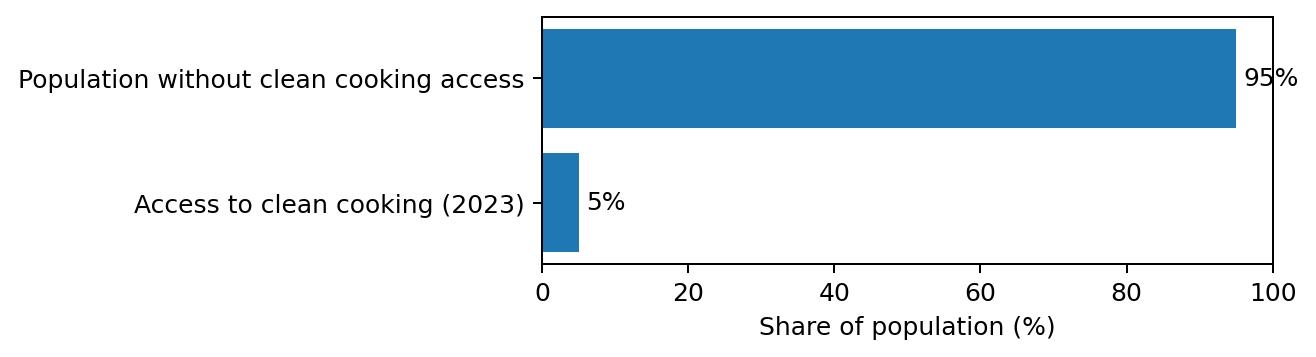
Clean cooking access gap in DRC. Source: Clean Cooking Alliance / World Bank data.
Why Biomass Stoves Remain the Strategic Transition Solution
An immediate nationwide shift from raw biomass to LPG or electric cooking is constrained by limited electrical grid coverage, low purchasing power, and deeply embedded cultural cooking habits. High-efficiency biomass cookstoves serve as the critical transition technology. When project developers leverage carbon credit subsidies or RBF grants to lower upfront hardware costs, distribution can scale rapidly across urban centers like Kinshasa and rural provinces alike.
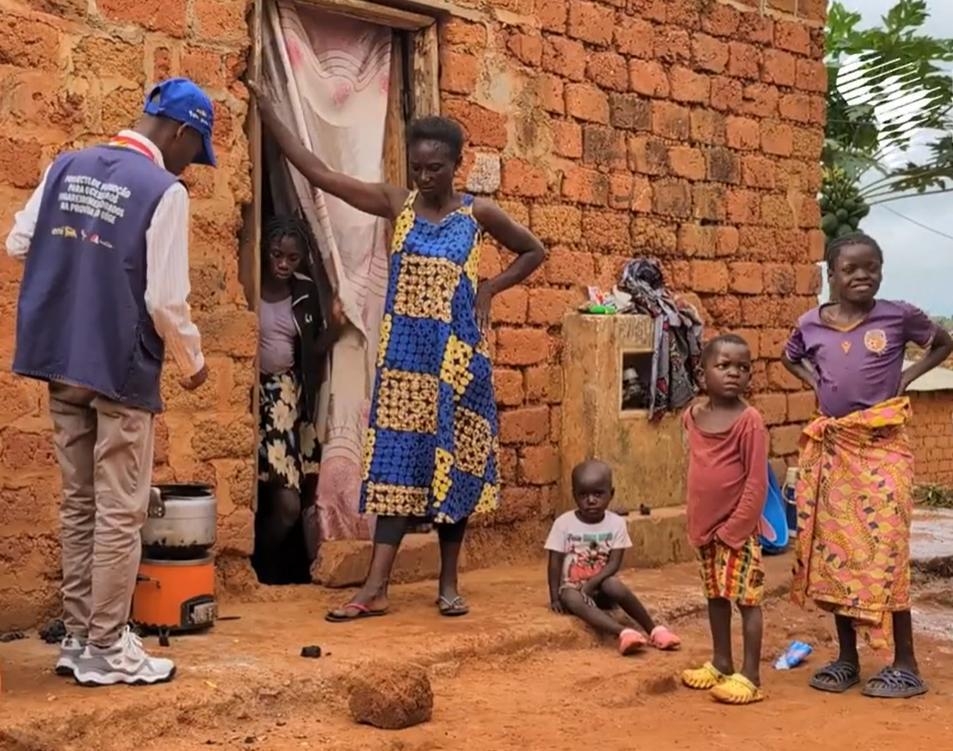
Household-level clean-cooking field engagement (illustrative SSM Eco fieldwork).
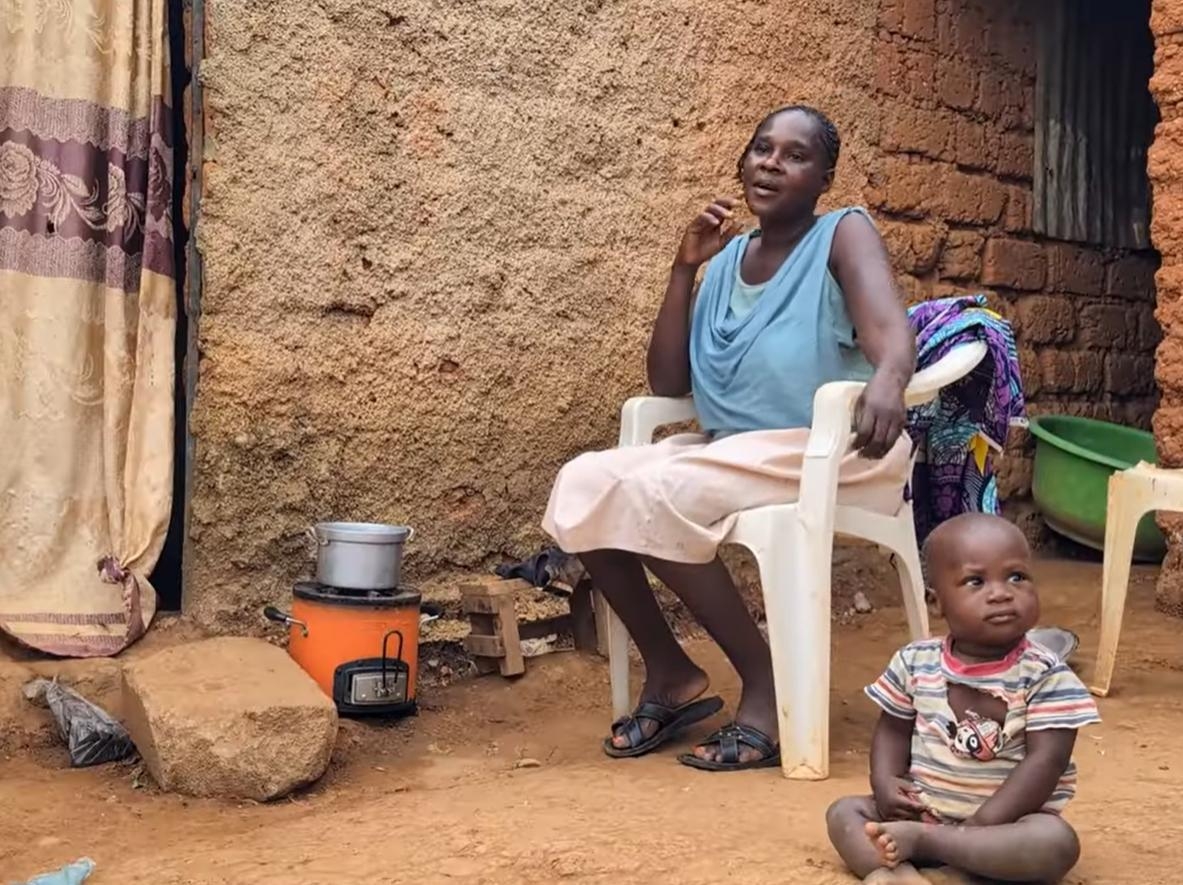
End-user context showing how improved cookstoves fit daily household life (illustrative SSM Eco fieldwork).
DRC policy is aggressively moving toward large-scale clean cooking deployment. The nation's updated Nationally Determined Contribution (NDC) targets clean cooking access for 3 million households by 2030. Substantial multilateral funding mechanisms back this mandate:
World Bank FOREST ProgrammeLaunched an RBF mechanism in February 2026 and aims to equip 500,000 households (about 2.5 million people) with clean cooking solutions. The first phase is targeting more than 110,000 stoves, followed by about 390,000 additional units. The World Bank reports USD 20 million co-financed by IDA and ESMAP for the clean cooking expansion, with payment based on verified stove sales/results rather than inputs.
UNCDF / CAFI / FONAREDD PED1 (2020–2025)
Supported the distribution of 300,000+ improved cookstoves, reached more than 2 million people and mobilized USD 22.5 million from USD 2.15 million deployed.
PED2 (launched 2026)
A USD 50 million national programme using grants, concessional loans and guarantees to scale clean cooking, electrification and sustainable biomass investment.
Mission 300
The World Bank notes DRC has a commitment to reach 40 million people with clean cooking by 2030, reinforcing the scale of expected public and private activity.
Commercial Implication
The most valuable prospects may not be conventional importers. They may be carbon project developers, RBF recipients, climate-finance companies, NGOs, local stove enterprises and Article 6 developers that need reliable products, traceability and long-term supply.
A conventional route to market is price-driven: Manufacturer → Importer/wholesaler → Retailer → Household.
For a carbon project developer, the stove is not evaluated only on FOB price. Efficiency, emissions, durability, lifespan, field performance, serialisation, monitoring requirements, warranty and consistency of supply can directly affect project economics and crediting integrity. A supplier able to support technical documentation, QC, traceability and local assembly can therefore be more valuable than the lowest-priced exporter.
This report uses HS 7321.19.00 for complete, non-electric iron/steel cooking appliances using solid fuel such as charcoal or firewood. For planning purposes, the calculation below uses a 20% customs-duty assumption for finished stoves, consistent with DRC's top standard import-duty band. The exact tariff line should be reconfirmed by the importer or customs broker before shipment.
DRC standard VAT is 16%. PwC states that import VAT is normally charged on customs value plus customs duty and import-related expenses. DRC imports can also attract administrative, OCC, OGEFREM, FPI and inspection-related charges. The FPI states that its 2% import levy is calculated on CIF value plus customs duty.
| Charge | Planning basis used in this report |
|---|---|
| Import Duty | 20% of CIF — planning assumption for finished stove |
| Administrative payment | 2% of CIF |
| OCC | 1.5% of CIF (PwC planning basis) |
| OGEFREM | 0.58% of CIF |
| FPI / TPI-I | 2% of (CIF + customs duty), per FPI |
| BIVAC / inspection | 1.5% of FOB in PwC summary; U.S. Trade Administration describes a different OCC/BIVAC collection mechanism |
| Import VAT | 16% of customs value + customs duty + import-related expenses |
Assumption: FOB USD 9,000 + freight/insurance USD 1,000 = CIF USD 10,000. This is a planning model, not a customs quotation.
| Charge | Calculation | Estimated amount |
|---|---|---|
| Import Duty | 20% × 10,000 | USD 2,000.00 |
| Administrative payment | 2% × 10,000 | USD 200.00 |
| OCC | 1.5% × 10,000 | USD 150.00 |
| OGEFREM | 0.58% × 10,000 | USD 58.00 |
| FPI | 2% × (10,000 + 2,000) | USD 240.00 |
| BIVAC / inspection | 1.5% × 9,000 | USD 135.00 |
| Import VAT | 16% × estimated taxable import value | USD 2,045.28 |
| Total statutory taxes/charges | USD 4,828.28 |
Practical Estimate
CIF USD 10,000 → approximately USD 4,828 in import taxes and statutory charges under the conservative PwC-style planning model → approximately USD 14,828 before clearing-agent fees, port charges, storage/demurrage and inland transport.
HS 7321.90.00 covers parts of the non-electric domestic appliances of heading 7321. A current tariff database lists a 10% default MFN duty for HS 73219000 in DRC. This makes genuine parts supply potentially more attractive than finished-stove import, particularly when combined with local fabrication and assembly.
| Charge | Calculation | Estimated amount |
|---|---|---|
| Import Duty | 10% × 10,000 | USD 1,000.00 |
| Administrative payment | 2% × 10,000 | USD 200.00 |
| OCC | 1.5% × 10,000 | USD 150.00 |
| OGEFREM | 0.58% × 10,000 | USD 58.00 |
| FPI | 2% × (10,000 + 1,000) | USD 220.00 |
| BIVAC / inspection | 1.5% × 9,000 | USD 135.00 |
| Import VAT | 16% × estimated taxable import value | USD 1,882.08 |
| Total statutory taxes/charges | USD 3,645.08 |
| Finished stove | Parts / CKD inputs | Difference | |
|---|---|---|---|
| HS code | 7321.19.00 | 7321.90.00 | — |
| Customs duty | 20% planning assumption | 10% default duty | −10 pp |
| Duty on CIF USD 10,000 | USD 2,000 | USD 1,000 | USD 1,000 lower |
| Estimated statutory taxes/charges | USD 4,828 | USD 3,645 | ~USD 1,183 lower |
| Indicative burden vs CIF | 48.3% | 36.5% | 11.8% of CIF saved |
Important Customs Risk
A complete stove cannot automatically become "parts" merely by shipping it disassembled. WCO General Interpretative Rule 2(a) states that complete or finished articles presented unassembled or disassembled are generally classified as the assembled article. If the shipment is essentially a complete stove kit requiring only assembly, customs may classify it under the finished-stove heading.
VAT note. PwC states that a business may generally offset VAT paid on business purchases against VAT charged on taxable sales, subject to DRC VAT rules. Import VAT can therefore be a cash-flow burden without necessarily being a permanent economic cost for a properly registered taxable business; this should be confirmed by the customer's local tax adviser.
The business case for local assembly is broader than customs-duty savings. Large clean-cooking programmes increasingly emphasize local jobs, local enterprise capacity, after-sales service and sustainable supply chains. FOREST explicitly supports local firms across manufacturing, distribution and after-sales service.
DRC investment incentives may further improve the economics of a genuine manufacturing project. ANAPI states that approved investments may receive exemptions from import duties and taxes on machinery, materials and equipment, subject to conditions; VAT may be paid upstream and reimbursed under the investment regime. ANAPI also states that approved SMEs/SMIs can receive import-duty exemptions on industrial inputs needed for the approved investment.
Phase 1
ObjectiveFast pilot / market validation
China supplyComplete stove
DRC activityDistribution / service
Import costHighest
Project storyProduct deployment
Phase 2
ObjectiveLower logistics and build local capacity
China supplyMajor components + tooling + jigs
DRC activityAssembly, QC, packaging
Import costPotentially lower
Project storyLocal jobs + assembly
Phase 3
ObjectiveLong-term scale and local content
China supplyCore combustion components + equipment + know-how
DRC activitySheet-metal fabrication, welding, finishing, assembly, QC
Import costPotentially lowest if incentives / local sourcing apply
Project storyTechnology transfer + jobs + industrial capacity + carbon impact
Clarify deployment geography and fuel mix first. Kinshasa and other urban centres strongly support a charcoal stove proposition; rural/peri-urban projects may require wood or hybrid options.
Use a pilot phase before heavy factory investment. Validate stove acceptance, cooking practices, fuel savings, durability, MRV process and distribution cost with a manageable first batch.
Offer the customer two commercial quotations in parallel: (A) finished stove, and (B) qualifying parts / local assembly, both with transparent landed-cost assumptions.
For local assembly, avoid a simple "complete kit in a box" structure. Design a genuine localisation plan with local material sourcing, fabrication, welding/painting, packaging and QC where practical.
If the project is multi-year and volume is substantial, prepare an ANAPI investment-incentive assessment before committing to plant capex. The customer should confirm whether its entity/project qualifies and obtain formal approvals before assuming exemptions.
Build the carbon-project package around efficiency/emissions test data, expected stove life, serial number or QR traceability, production-batch records, warranty, after-sales process and MRV support — not only unit price.
DRC combines an unusually large clean-cooking deficit with expanding climate finance, RBF programmes, carbon-market activity and increasing attention to local industrial capacity. The market is already operating at hundreds-of-thousands-of-stoves scale across major programmes and commercial developers, while more than 100 million people still lack access to clean cooking.
For an international cookstove manufacturer, the strongest long-term position is broader than "supplier." The more valuable role is a project and manufacturing partner: providing project-ready stoves, dependable production, transparent landed-cost models, traceability, QC and a realistic pathway from finished imports to local assembly and manufacturing.
SSM Eco has nearly five decades of experience in the clean cooking stove sector. The product range includes wood, charcoal, pellet and institutional stoves, with over 11.3 million stoves delivered to date. We work with international energy companies, carbon project developers, NGOs and humanitarian organisations to promote sustainable cooking solutions and carbon-emission reductions.
Whether you need finished stoves for a pilot phase or a phased local-assembly strategy, SSM Eco can support your project with manufacturing quality, transparent cost models, and traceability.
This report is a practical commercial overview prepared from public sources checked in September 2026. Market figures, programme targets and tax assumptions can change. Customs classification, customs value, exemptions, VAT recovery and parafiscal charges should be confirmed with the DRC importer, DGDA/customs broker and local tax adviser before a transaction. The finished-stove 20% rate is used as a planning assumption and should be confirmed at tariff-line level. The 10% rate for HS 73219000 is based on a current commercial tariff database and should likewise be confirmed by DGDA.
Latest News


